Friday, March 11, 2022

a brainy birthday

Today is the day that Facebook is made for, and look how it makes sure I don't miss it somehow! Poetry Friday friends, whatever it says about me, I now claim the truth that I like a little fuss about my birthday, so yup, let me post about celebrations, age and mortality.  And sheep's brain. 


It is important to remember that you will die,
lifting the fork with the sheep's brain
lovingly speared on it to the mouth: the little
piece smooth on the one side as a baby
mouse pickled in wine; on the other, blood-
plush and intestinal atop its bed of lentils.
The lentils were once picked over for stones
in the fields of India perhaps, the sun
shining into tractor blades slow moving
as the swimmer’s arms that pierce,
then rise, then pierce again the cold
water of this river outside your window called
The Heart or The Breast, even, but meaning
something more than this, beyond
the crudeness of flesh, though what
is crude about flesh anyway, watching yourself
every day lose another bit of luster?
It is wrong to say one kind of beauty
replaces another. Isn’t it your heart
along with its breast muscles that
has started to weaken; solace
isn’t possible for every loss, or why else
should we clutch, stroke, grasp, love
the little powers we once were born with?
Perhaps the worst thing in the world
would be to live forever.
Otherwise, what would be the point
of memory, without which
we would have nothing to hurt
or placate ourselves with later?
Look. It is only getting worse
from here on out. Thank God. Otherwise
the sun on this filthy river
could never be as boring or as poignant,
the sheep’s brain trembling on the fork
wouldn’t seem once stung
by the tang of grass, by the call
of some body distant and beloved to it
still singing through the milk. The fork
would be only a fork, and not the cool
heft of it between your fingers, the scratch
of lemon in the lentils, onions, parsley
slick with blood; food that,
even as you lift it to your mouth,
you never thought you’d eat. And do.
 
from Imaginary Vessels. Copyright © 2016
 

I could write a thousand birthday poems and none of them would feature sheep's brain, "food that...you never thought you'd eat," and wouldn't. But isn't that the wonder of a well-constructed poem, a life of reading deeply? That we can find the part that applies, and then apply the part we can find that stretches sensation, emotion?  That we can begin to imagine a life in which we are named Paisley and eat lentils and sheep's brain beside a filthy river with gratitude for the tang of grass, the scratch of lemon?

The Poetry Foundation also gifted me today with this brief but full article about days full of poet birthdays.  Enjoy! 

We are rounded up today by dear Sylvia and Janet at Poetry for Children, where they are celebrating the publication of their newest Pomelo anthology, THINGS WE EAT.  I don't believe it contains sheep's brain. 😊

Friday, March 4, 2022

quotable: all we can save

Greetings, all!  It's the first Friday of the month, the world is watching with anxious eyes as both a war and a shift in global politics takes place, and just to keep our hearts full, the Inklings are writing to a challenge set by Margaret Simon:

"Choose a quote that speaks to you. Write a poem that responds to the quote. The words can be used as a golden shovel or throughout the poem or as an epigraph."

It just so happens I have a little something I prepared earlier to answer this challenge. I participated again this year in Laura Shovan's February Poetry Project, where a group of about 40 write to a daily prompt on a theme and share and respond to each others' poems. It's a great experience in so many ways and I always come away with a pile of drafts I wouldn't have written otherwise. This year the theme was TIME.

It was a prompt from Lisa Vihos on February 11 that reminded me I owned the climate-feminist anthology ALL WE CAN SAVE: Truth, Courage and Solutions for the Climate Crisis, the book I posted about a couple of weeks ago (here's the website/newsletter/ community). 

She shared an excerpt from an essay by Sherri Mitchell, "Indigenous Prophecy and Mother Earth," included in the book.  This essay comes from the first of eight sections in the book, called "Root". I chose a different striking line and wrote this golden shovel.


Here's Sherri Mitchell reminding us how the body keeps the score.


That's the whole post for today [EDIT: NO IT ISN"T!  I have neglected to link to my fellow Inklings posts!]  Check out whom and how the rest of the Inklings quoted and wrote!

Mary Lee Hahn @ A(nother) Year of Reading 
Molly Hogan @ Nix the Comfort Zone

Linda Mitchell @ A Word Edgewise
Margaret Simon @ Reflections on the Teche

Kat Apel is rounding us up today at Kat's Whiskers, and sharing her newly released book!  See you there.


Friday, February 25, 2022

every month is black history month

Greetings, Poetry Friday friends.  We all make a fuss, don't we, when people act like April is the only month we should pay attention to poetry--but maybe we also fall into that fallacious trap, forgetting that Black history is important every month, women's history is important all year, indigenous and Latin American history is important every day.

You might say, "Well, I'M important every day of the year, but I'm good with celebrating just once, on my birthday."  And yes, practically speaking, there's only so much we can celebrate on any given day.  (I personally gave up long ago even acknowledging Groundhog Day in school--omg, there are a thousand more important things to do than make a fuss over a nonscientific and possibly animal-abusive event, although I do rate the movie as making an important contribution to the culture.)

But, in the same way that we now acknowledge the power of asserting that Black Lives Matter, I don't want to let February pass without saying Black History especially Matters, reparatively Matters, every month, because we have got some catching up to do, people.  So I'm grateful to Poetry.org for reminding me regularly to attend to Black voices, and to Afaa Michael Weaver for this poem of recent history, current events, today's rehearsal of historical pain and glory, the gift of Black history every month.

You may have received this too, but even so let's read it again, out loud.


Midnight Air in Louisville

Afaa Michael Weaver
for Breonna Taylor

Dear Breonna,
How many times, I ask,
           how many times
have I chased the thought
                      of writing to you,
of catching the poem where
                      it cannot leave,
of knocking open the door to a grief
           we all hold, our hearts
full of questions.
           We leave our houses to work,
to look for what we need to live,
                      or what we need
           to make the pain go away,
and your voice rises:
           “Oh hell to the no,
no he didn’t,
           Satan get behind me,
whatever, whatever
           the hell you think you are.”

I imagine that in leaving 
all of us you said:
           “I am done
I am let out into the world,
           breath I took in from it
breath that I give back in love.”

May I see you in flight
filling the space
           beyond clouds and stars
where there is no need
           of sun or moon, where
a grand city lives
           in prophecies beaten
by the wheels of history
where you are not invisible
           to ancestors who saw
these long roads down through time
to this one night in Louisville.

                      Bright Angel,
Luminescence, Woman Who Saved Lives
in Emergency Rooms,
                      Invocation of Heaven’s Law,
Living Song Riding
                                 the Eternal Dawn.

These titles I summon from license
given by Eternal Mysteries to hold you.
Fly now, in the woven air of the saints.

***********************
Enough said, or do I need to speak it again?  I do. 
"Fly now, in the woven air of the saints."
 

Tricia at The Miss Rumphius Effect rounds us up today with some (oh dear) Exquisite Corpse play with the Poetry Sisters.


Friday, February 18, 2022

all we can save: truth, courage and solutions


Greetings, Poetry Friday audience! It's the 3rd Friday of the month, when you'll find me considering our response to the climate crisis. Now, I am no expert in much that's related to global warming--not the exact science of its causes, not the relative power of various solutions, not the numbers that quantify the damage--but I am an expert in CARING about it (and lots of other things. In general, when I see something, I say something--and my Outbox is full of Strongly Worded Letters to prove it).  And I've learned that it's of basic importance to climate action to CARE about the Earth and its beings.  

I'm pretty sure we are all past that basic level here; poets in general are poets because they've fallen hard for the wonders of nature, the miracles of life.  Much harder is to sustain attention to the truth about what's happening the climate and connect that to courageous actions that solve it. Anyone who can help us with that, we want to know them!

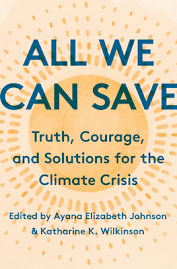
Today I want to introduce us all to a book I bought last summer and didn't get around to cracking open until this week, and girl am I sorry about that!  I thought I knew what was in it--essays--and what they were about--climate stuff--and I bought it mainly to support Ayana Elizabeth Johnson, whose podcast I have loved and written about before.

But friends, this book turns out to be a book of POETRY.  Yes, there are essays, and yes, it's about climate stuff, but when Ayana and her coeditor Katharine K. Wilkinson say ALL WE CAN SAVE: Truth, Courage, and Solutions for the Climate Crisis, they are saying that in order to get to the solutions, we need the kind of truth and courage we get from POETRY.

And so this book--which "illuminates the expertise and insights of dozens of diverse women leading on climate in the US," features poems by names I know (Ellen Bass, Marge Piercy, Joy Harjo, Ada Limon, Patricia Smith, Jane Hirshfield, Damille T. Dungy, Sharon Olds, Alice Walker and Mary Oliver), and names that are new to me (Lynna Odel, Ann Haven McDonnel, Joan Naviyuk Kane, Ailish Hopper, Catherine Pierce, Naima Penniman).

Would anyone like to read it WITH me?  For all kinds of reasons, I know I'll jump in and stay in if others are expecting me to. It's 375 pages and 8 sections, with most essays  7-8 pages long, some shorter, some a few pages longer.  I know there are folks here who read several books per week, but I'm slow enough with everything else to propose reading (and digesting) maybe one section a week, and meeting to discuss once a month.  If you're interested, let me know in the comments or email me--a group of 4 would be a good minimum.

And now, to offer you both truth and courage, here's one poem from the book, also found at Poets.org:

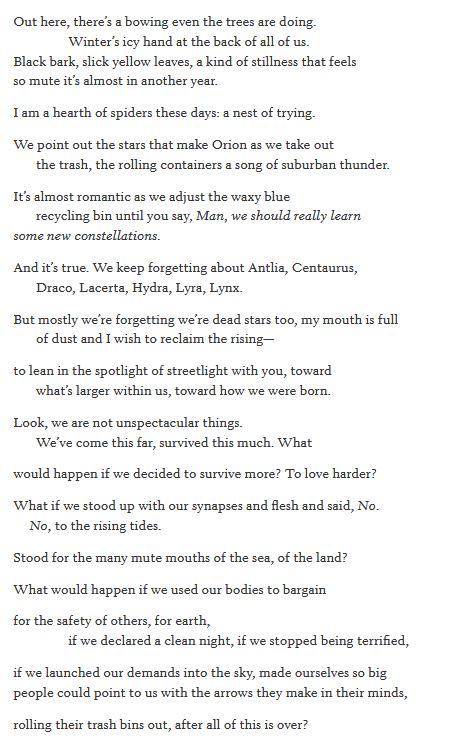
Dead Stars | Ada Limon


From The Carrying (Milkweed Editions, 2018) by Ada Limón. Copyright © 2018

Thanks to our host for today, Laura  Purdie Salas, who has perhaps wisely decided not to write the whole entire world for kids but to offer us "Small Reads for Brighter Days." Either way, it's always lovely over there!

Friday, February 11, 2022

love at all times, of all kinds


Greetings, Poetry Friday venturers! It's getting on for Valentine's Day--an annual celebration which, despite being weighed down with roses & chocolates & sappy Hallmark cards, is among my favorites.  What's not to love about love? Philial, erotic, agape, pragmatic, playful--I find I had some things to learn about the 8 kinds of love identified by the Greeks (yes, I'm directing you to lifehack.org!), and here's one for us all to know:  

PHILAUTIA, self-love...the good kind, the kind where we are compassionate and affectionate to ourselves, which then allows us to truly love others.

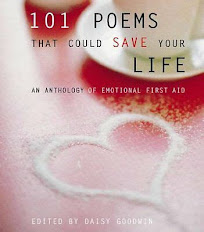
On my shelf is a wee British book called 101 Poems That Could Save Your Life: An Anthology of Emotional First Aid (ed. Daisy Goodwin).  Look at that cover and you'll see why I thought of it this morning!  And inside, one of the best poems of philautia I know--maybe you do too.


Love After Love | Derek Walcott

 
The time will come
when, with elation
you will greet yourself arriving
at your own door, in your own mirror
and each will smile at the other's welcome,

and say, sit here. Eat.
You will love again the stranger who was your self.
Give wine. Give bread. Give back your heart
to itself, to the stranger who has loved you

all your life, whom you ignored
for another, who knows you by heart.
Take down the love letters from the bookshelf,

the photographs, the desperate notes,
peel your own image from the mirror.
Sit. Feast on your life.


Let us go forth, whatever our relationship status, whatever the state of our routines, our ambitions, our creaky, crooked, creative, colorful bodies, and greet ourselves with love. Linda, the lovely one of TeacherDance, hosts our Poetry Friday lovefest today.

 ♥️♥️♥️♥️♥️♥️

P.S.  If I am slow to comment on your PF posts this weekend, it's because I'm attending the SCBWI Winter Conference online.  Some parts of it are free and open to the public.  See below for a couple of sessions you can attend virtually this evening.

1 pm-2 pm Pacific/4-5 pm Eastern
Orientation for Newcomers with Jolie Stekly
Free and Open to the Public!

2:30 pm-3:15 pm Pacific/5:30 pm-6:15 pm Eastern
Everything Changes, Nothing Ends:
Telling Stories with Brian Selznick
Free and Open to the Public!


Friday, February 4, 2022

no, no, nonet

Greetings, Poetry Friday friends, and happy February!  Many in this community are participating with others outside it in Laura Shovan's 10th Annual February Poetry Project.  The theme this year is TIME--which is apropos, in that this week I suddenly found myself with very much less time than I did in January, when the combination of weather and Omicron led to quite a few unexpected free hours.  All the February dailies of regular school and AFPP prompts have led me to a LaMiPoFri situation with the monthly challenge of the Inklings (which I remembered at 10:30pm last night. *sigh*).

This month, Catherine Flynn set us a worthy and welcome challenge:

Write a mathematical poem, such as a fib, pi poem, nonet, etc. Find inspiration here: https://poetrywithmathematics.blogspot.com/ or here: https://www.acornnaturalists.com/blog/stem-poetry/ or here: http://mathematicalpoetry.blogspot.com/2010/06/4-types-of-mathematical-poems.html  Feel free to interpret this challenge in any way that feels right for you. Have fun!


I'm saying yes, yes to the nonet, a (probably deceptively) simple-syllable count form you can read about with Billy Collins here: 9 lines, counting down from 9 syllables in the first line to 1 in the last--or, as amply demonstrated in Nine: A Book of Nonet Poems by our friend Irene Latham, the reverse. That allows for a total of 45 syllables either way....


Et voilà my naughty late nonet! One can always find something to say about the weather.


Wishing all our friends safe and cozy snow'n'ice days where that applies, thanking Catherine and the rest of the Inklings (see below) for the camaraderie of the challenge, and appreciating Elisabeth at Unexpected Intersections for hosting us today! 


-Catherine at Reading to the Core
-Linda at A Word Edgewise  -Margaret at Reflections on the Teche


Friday, January 21, 2022

dive deep


Greetings, All.  It's the 3rd Friday of the month, the one where Poetry Friday meets Fridays for Future and we focus on climate issues. Let's take a look at the Climate Clock.

As we contemplate how little time we have left to limit global warming to 1.5*C, let's also consider this enormous news: I drove through McDonald's today (why and whether that's a good use of my climate activist economic pressure is a topic for another time) and realized that my new reusable straw was not in my bag.  It's hard to drink in the car (a birthright of the American consumer) without a straw, so reluctantly I popped open the wrapper on the McD's straw AND DISCOVERED IT WAS PAPER, 100% PAPER!!!  That, my friends, is progress, and SOMEONE (someone you know?) has been badgering McDonald's to make that happen. Cheers to the straw activists!

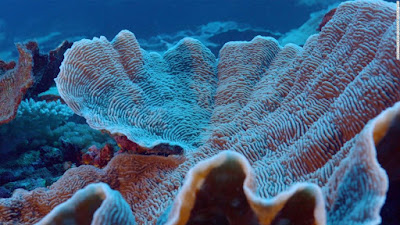
Here's another cause for celebration: "Deep in the ocean off the coast of Tahiti, scientists made an incredible discovery in November: acres of giant, pristine, rose-shaped corals blossoming from the sea floor in what's known as the ocean's "twilight zone.""


The research mission, led by UNESCO, found the reef stretches for nearly two miles and exists at depths down to 70 meters, or 230 feet. This is around the ocean's "twilight zone," where there's just enough light to sustain life, and below which the ocean transitions into a dark abyss."For once, it's a positive story about coral reefs in the news, which is quite rare these days," Julian Barbiere, head of marine policy at UNESCO, told CNN.

Indeed, this news has got me bobbing about and feeling pink and positive somehow, like "WEHAVEN'TDESTROYEDEVERYTHINGYET!"  And, if we didn't know this reef was even there, maybe that means there's so much else we don't know, that we can discover, that might save us.

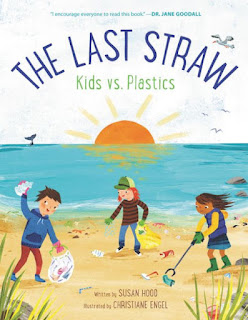
Now, to connect the straw to the reef, I want to make sure you all know about this book, THE LAST STRAW: KIDS VS. PLASTIC, an NCTE Notable Book for 2021, by Susan Hood.

From Kids Book a Day: "Following an introduction by 9-year-old Milo Cress, founder of Be Straw Free, this poetry collection looks at different aspects of plastic, from its undeniable usefulness in many areas to the damage it is wreaking on the environment (especially the oceans) to different ways kids and teens are figuring out to recycle and find alternatives to plastic.  

The poetry is just the beginning in this book that is jam-packed with information and inspiring stories about kids working to make a difference in the world by recycling or eliminating plastics.  The colorful illustrators add a lot to the poems, and the 13 pages of back matter... make this an excellent resource for older kids."

Here's one poem from that book to enjoy with the younger readers you know, and one from the Poetry Foundation for you.
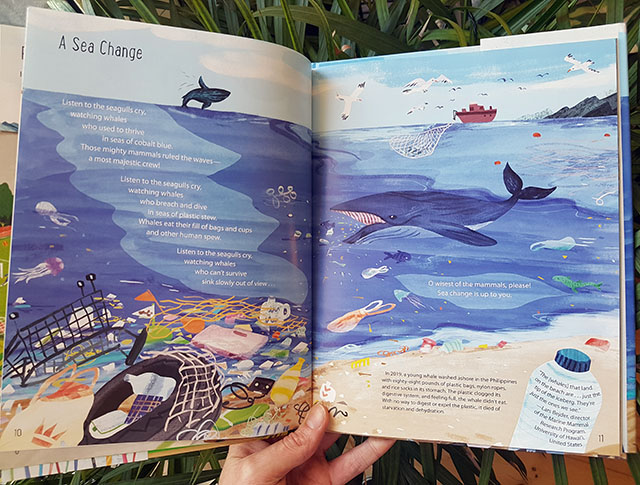
illustrations by Christiane Engel


 A Sea Change | Susan Hood
 
Listen to the seagulls cry,
    watching whales
        who used to thrive
            in seas of cobalt blue.
    Those might mammals ruled the waves--
        a most majestic crew!
 
Listen to the seagulls cry,
    watching whales 
        who breach and dive
            in seas of plastic stew.
    Whales eat their fill of bags and cups
        and other human spew.
 
Listen to the seagulls cry
    watching whales
        who can't survive
            sink slowly out of view.
    O wisest of the mammals, please!
        Sea change is up to you.


Pot of Gold |  Ingrid Wendt

For Elizabeth Bishop, 1911–1979, with gratitude

We talk, you and  I, of  mindfulness, here in the world above
          water, but what’s below is watchfulness,
                     pure and simple: creatures trying not to be eaten,
          creatures relentlessly prowling or simply waiting for meals to
 
cruise on by. Except maybe parrotfish.
          Ever industrious, ever in motion, it’s hard to find one not
                     chomping on Yucatán limestone reefs. What we see as
          dead, bleached coral or crusted limestone shelves, for them

is re-embodied Fish Delight. Which means I find them by
          eavesdropping. Ah, those castanet choruses clicking, clacking,
                     a coven of  promises leading me on until there:
          below my mask and snorkel, a dozen or more upside-down

Princesses sway as one, in their pink and blue checkerboard
          gowns, their long, long dorsal crowns
                     cobalt-striped, and turquoise, and fuchsia—useless—
          no Prince to be found, not even in fish identification books,

just me and my ardor. Bewitched, each day I hang, transfixed,
          above them in a slightly different
                     place in that once-pristine, once-undiscovered Yal-Ku lagoon,
          its cradling mix of salt and fresh water

letting me hold myself, and time, and the rest of the world
          stock still.         [read the rest here; the ending is worth the click]

 ****************

And now, before you go, click on over to  Oceana, a Charity Navigator 4-Star outfit, to learn more about one of the world's biggest plastic polluters (yeah, you guessed it--Amazon) and to take a little action.

Our Poetry Friday host today is Tabatha at The Opposite of Indifference, where her puzzling reflections and poem fit nicely with the idea that we all have a part to play in changing the way humans live on our home, the Earth.


Friday, January 14, 2022

it takes practice


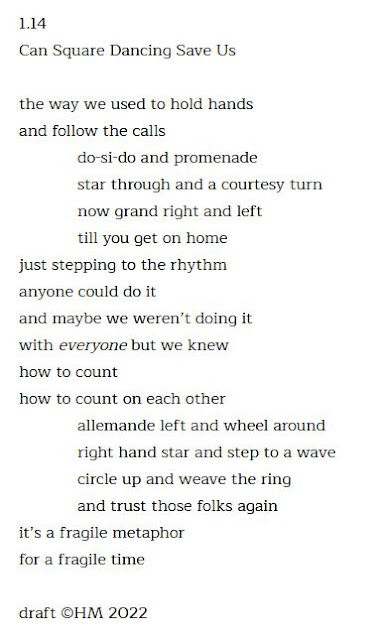
Greetings on this heavy-feeling Friday.  I have no spiffy feature today, no OLW or big ol' project to announce, just a really rough and possibly problematic draft that started with a thought I had waiting at the lights on my bike yesterday.  Apparently David Brooks was having the same kind of thoughts, but he clearly never participated in a Friday Night International Folk Dance Club like I did growing up. He offers no solutions.


 Here are the necessary audiovisuals:


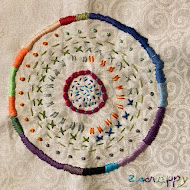
Our host today is the colorful and prolific Mary Lee of A(nother) Year of Reading, who also kindly schedules our hosting duties every six months and is generally a human of the finest fabric.  I thank her for letting me use her stitching to illustrate this post about falling apart at the seams.


Thursday, January 6, 2022

winter poem swap & the lost lagoon challenge

Greetings once again, Poetry Friday people. As promised I'm extending the pleasure of joining the Winter Poem Swap and getting to know Tanita better by sharing it with you today, well into January!  Below this you'll find January's Inklings poem challenge as well.

Tanita knows that my family starts our winter holiday with a celebration of the Shortest Day, the Longest Night, on the Winter Solstice. She also knows that I've often and recently used the acrostic to get a draft off the ground. Her poem is truly tailor-made for me, and incorporates all her gorgeous command of rhyme, rhythm and a slightly formal, archaic diction which fits the observance of the Solstice, a practice that reaches us from deep prehistory (and yet which happens right now too, every year!).

See how it's a little wrinkled?  I keep carrying it from room to room with me.

 Now if I could beg your indulgence:  please read this poem aloud while playing the following sound clip from the equally gorgeous handmade titanium wind chime that accompanied the poem.  You see it above in a photo which shows it hanging  before the sliding doors in my Library Lounge; it is both cozy inside and snowy outside at the same time!

<titanium-wind-chime-winter-rising>

I'm so delighted with every part of this gift--"Now wakes the wind.  It whisks the barren ground/Verdant beneath, as sprightly seedlings sleep"--which is always my greatest hope at this time of year. Sunlight is indeed unconquered, no matter what we may do to Earth; let 2022 be the year when each and all begin truly to conquer our misuse of her riches. Thank you, Tanita!

*************************

 It's the first Friday of the month, so we Inklings are again undertaking a challenge, this time set by me.  Despite my swoon over Tanita's gorgeously "old-fashioned" poetry it's not often I go for that, but every now & then something strikes my fancy, and this poem by Emily Pauline Johnson (who also published under her Mohawk name Tekahionwake and was born 1861 on the Six Nations Reserve, Canada West) captivated me.


The Lost Lagoon

It is dusk on the Lost Lagoon, 
And we two dreaming the dusk away, 
Beneath the drift of a twilight grey— 
Beneath the drowse of an ending day 
And the curve of a golden moon.

It is dark on the Lost Lagoon,
And gone are the depths of haunting blue,
The grouping gulls, and the old canoe,
The singing firs, and the dusk and—you,
And gone is the golden moon.

O lure of the Lost Lagoon—
I dream to-night that my paddle blurs
The purple shade where the seaweed stirs—
I hear the call of the singing firs
In the hush of the golden moon.


My challenge: "Use the form of this poem to build your own poem FOR CHILDREN about a treasured place that you return to again and again (geographical or metaphorical)." 
 
It seemed simple enough, but the form proved deceptive--and I counted wrong! I noted that the first four lines had 4 stressed beats each and that the last line of the stanza had 3...but in fact both L1 and L5 of each stanza have three beats. 
 
So my poem, like some of the others, departs from the form a bit, and doesn't quite have the same water-paddling rhythm--but there may be other pleasures lurking instead. See what you think.
 

 I bet I'm not the only one whose treasured place is the library, eh? I will say it worked better when I didn't have to keep an eye on the clock!
 
My school district has just announced a delayed opening tomorrow due to predicted snow that they have cancelled school***, so maybe by the time you read this, an 811 stanza will have been written! Here's where to find everyone else's treasured places.
 
 Thanks to Carol at Beyond Literacy Link who hosts us this week with a few One Little Words to get 2022 rolling, hopefully in a far more peaceful, prudent way.
 
***I am not one of my district's 10,000 students and staff currently infected with COVID. Woot. However, the closure today, while the district continues to say it's due to the max 2 inches of further snow, is really because they don't have enough staff to open the buildings. Here's a laugh:


Monday, January 3, 2022

Mordhorst Grant New Year's Letter 2021-22


Greetings!  

You've arrived here by following the Bitly link on our paper letter that Fiona, with great patience and respect for the traditions of British Christmas carding, has snail-mailed you.  Thanks for taking the trouble, and we hope you enjoy/learn something/get fired up by one or more of these posts.  Happy 2022!


 Heidi: 
 
Duncan: 
 
Daisy: 
 
Fiona:
 
Sending love from all of us!
xoxoxoxo