Please click below to find me at Substack, where you can SUBSCRIBE free to get every future post delivered straight to your inbox, or FOLLOW to see me pop up for you within Substack.
See you there!
https://heidimordhorstwhispershout.substack.com/

Please click below to find me at Substack, where you can SUBSCRIBE free to get every future post delivered straight to your inbox, or FOLLOW to see me pop up for you within Substack.
See you there!
https://heidimordhorstwhispershout.substack.com/
PLEASE NOTE: This is the last of my posts that you will find here at Blogger. *my juicy little universe* has now officially moved to Substack. Find me here from now on:
https://heidimordhorstwhispershout.substack.com/

My friend Mary Lee gave me this book just before we began preparing in earnest for the much-vaunted* temporary move to Brighton, England, this “junior year abroad,” as another someone I love brilliantly termed it. I would have wanted the book in any case, being generally a Maggie Smith fan, but this particular title feels particularly apt. It feels so apt that I’m going to be reflecting today on nothing BUT the title, since I haven’t yet read a single poem in it. However, it is noteworthy that A SUIT OR A SUITCASE is literally the only poetry book** I brought with me when we flew on August 28.
**This is an outright lie. Of course I brought many poetry books, like two dozen, in a hard-sided suitcase (looking at you, Janet Wong) that Fiona has owned since 1989 (the year that I did not marry her but someone else; see how much there is to unpack?). But the two dozen are MY books, a handful of essential anthologies (looking at you, Pomelo Books), and a minicollection of books I might use for a first “Spooky Poems” workshop for kids, if I can swing it. ASOAS is the only poetry book for ADULTS that I brought with me.

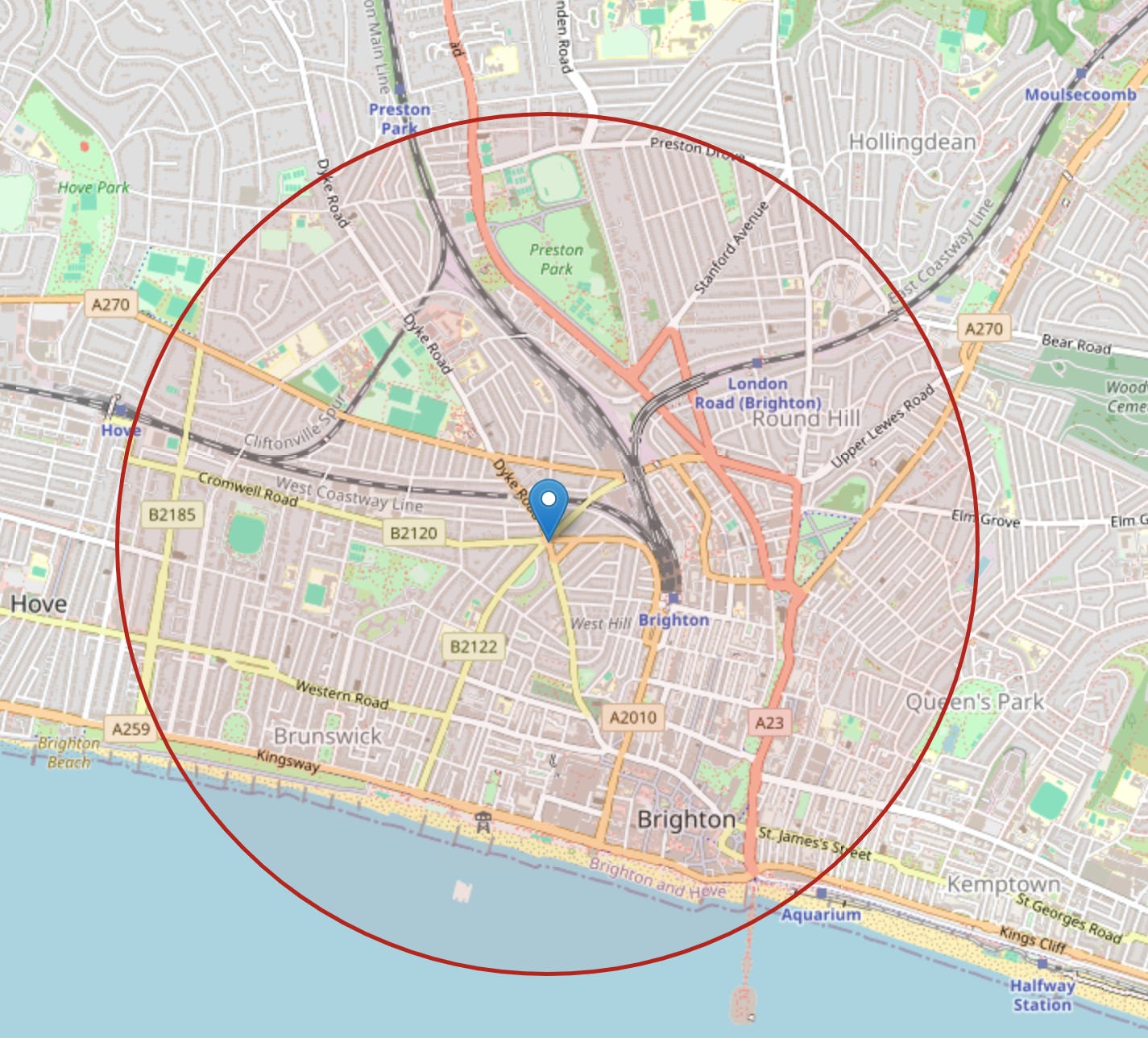
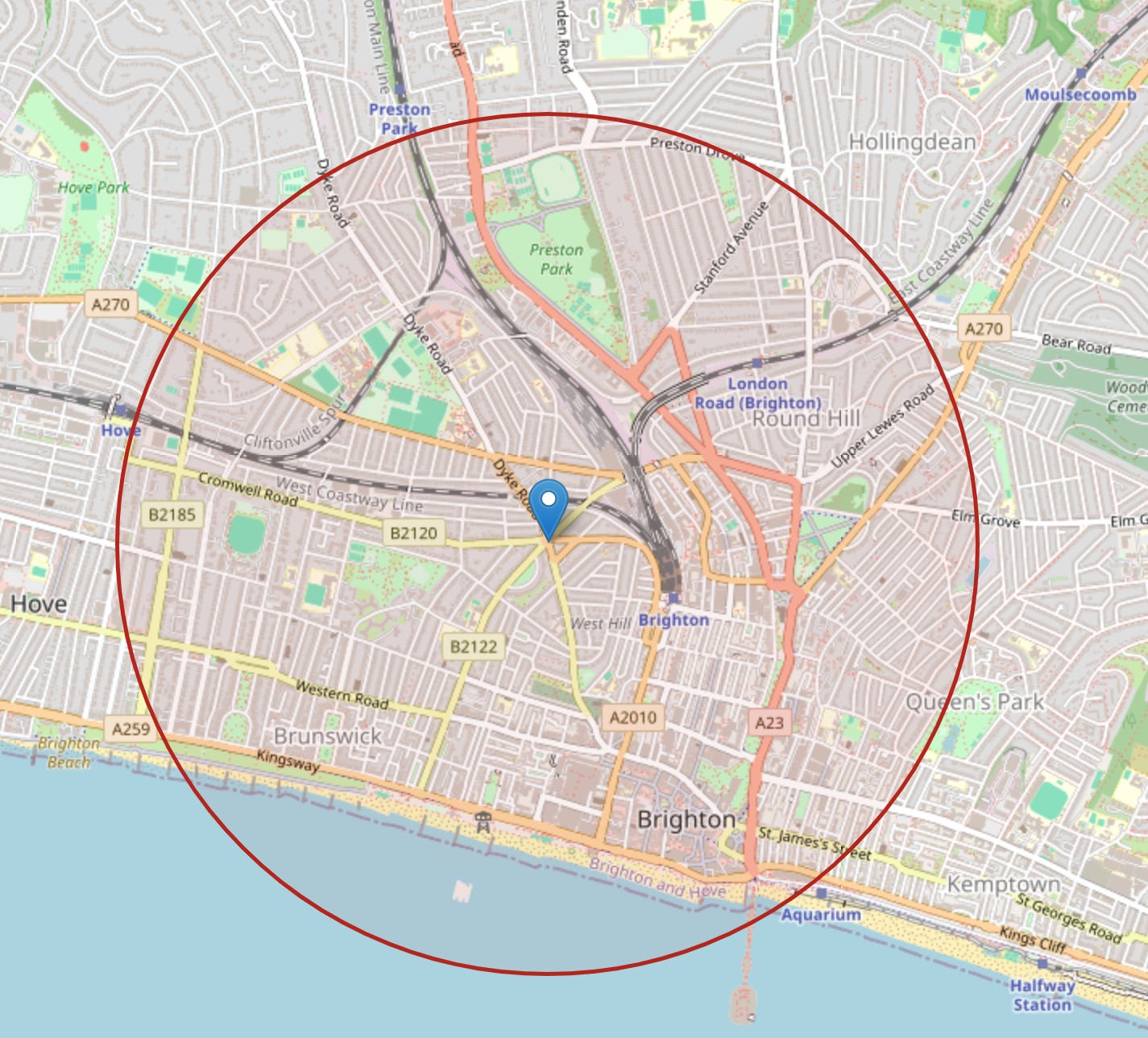
So here I am, on the fourth day of our occupation at No. 2 KittyCat Mews (the alias of our wee semidetached housie complete with walled garden), with suitcases unpacked and deliveries received from IKEA, etc….and so focused have I been on all the things—by which I mean the actual objects—that we consider needful for our little life here, that today is really the first time in weeks that I’m considering how this whole adventure suits me, how well suited I am to resettle once again in a new home 46 years after my first trip abroad in 1980 (to England, as it happens). Now that I have emptied the suitcases, do I have the right clothing? the right suit for the purpose? What is, what are, the purposes? A SUIT OR A SUITCASE…Or is that suitcase as in nutcase? Is a nutcase simply a shell for a nut, like a suitcase is simply a container for suits, like a suit is a simply a case for a body?
The blurb of Maggie’s book starts, “Is the body a suit or suitcase? Do I wear it or does it carry me?” I’m pretty sure that in the course of her book, Maggie’s going to get to an answer which isn’t any answer: “Both and neither; more than either.” At least that’s the answer I’ve been noodling on for some years now, and wow, does upping stakes and moving house focus one’s attention on the condition of one’s essential home, the body!
*Incidentally, “upping stakes” is nomadic for untethering your tent, rolling it up and moving on to the next temporary home. I tried really hard not to make such a big fuss about this temporary relocation as I did about the whole year when we took the kids, aged 4 and 8, to Paris—but all the fuss, the much vaunting, seems to be unavoidable. I have come to understand that my essential home, my body and all its mindful soulful contents, only feels really comfortable with a physical home around it. Oddly, that can be a treehouse or boxcar, a hotel room or guest room, an apartment or cottage, whatever! I can be pretty adventurous, AS LONG AS I am free to “dress” the home as suits me. I need to rearrange and optimize, forage and fix up, innovate and decorate. (The stated intention for KittyCat Mews is WHIMSY; see “The Farmyard” below, using only what I found already in the garden.)

So yes, I needed a couple dozen books, I needed some tablecloths and napkins, I needed the smallest possible reminders of various friends and relations, I needed the tongs I have used for 24 years which are like an extension of my cooking hand. I needed 2 works of art by my children and the hairclips of a particular size which are hard to get and who has time to track them down in Brighton? I am too busy visiting charity shops in search of whimsical mugs and, from the safety of this house, visiting new places, physical and metaphysical, to test my bravery. It’s not so much what I might encounter here that requires bravery; it’s what I’ve left behind, what it feels like I might lose—
and see, it’s taken me all this noodling to get to the crucial question. It’s not “Is the body a suit or suitcase?” but “Am I myself no matter where I am?” The books, the napkins, the tongs, the art, the hairclips are all to remind me who I am, suggesting that there’s some work to do on tethering the interior of the tent.
So here’s an Instadraft in response to Margaret’s Inklings Challenge to try a poem that includes a kenning, “a figurative compound word that takes the place of an ordinary noun.”
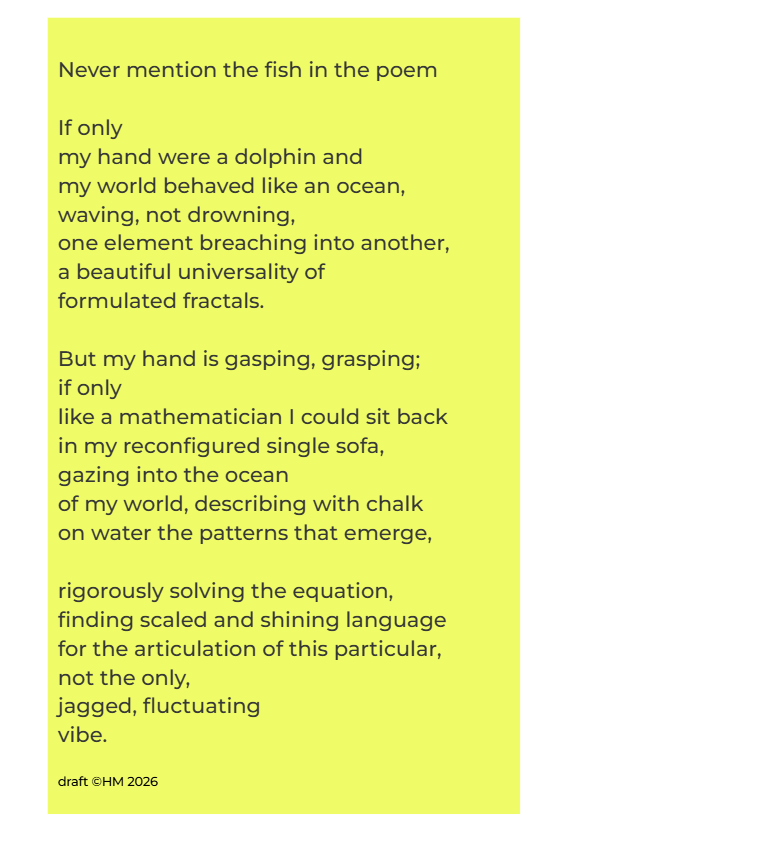
anchored inside a circle of tent-stakes
trailing turquoise and green, black, blue and red
I write myself bigger on the inside***
Thanks to Patricia at Reverie for hosting us all today! Looking forward to getting back in the groove this weekend, and to reading the kennings of other Inklings.
***I aspire to be dimensionally transcendental, don’t you?
Click! Read! Share! Subscribe!
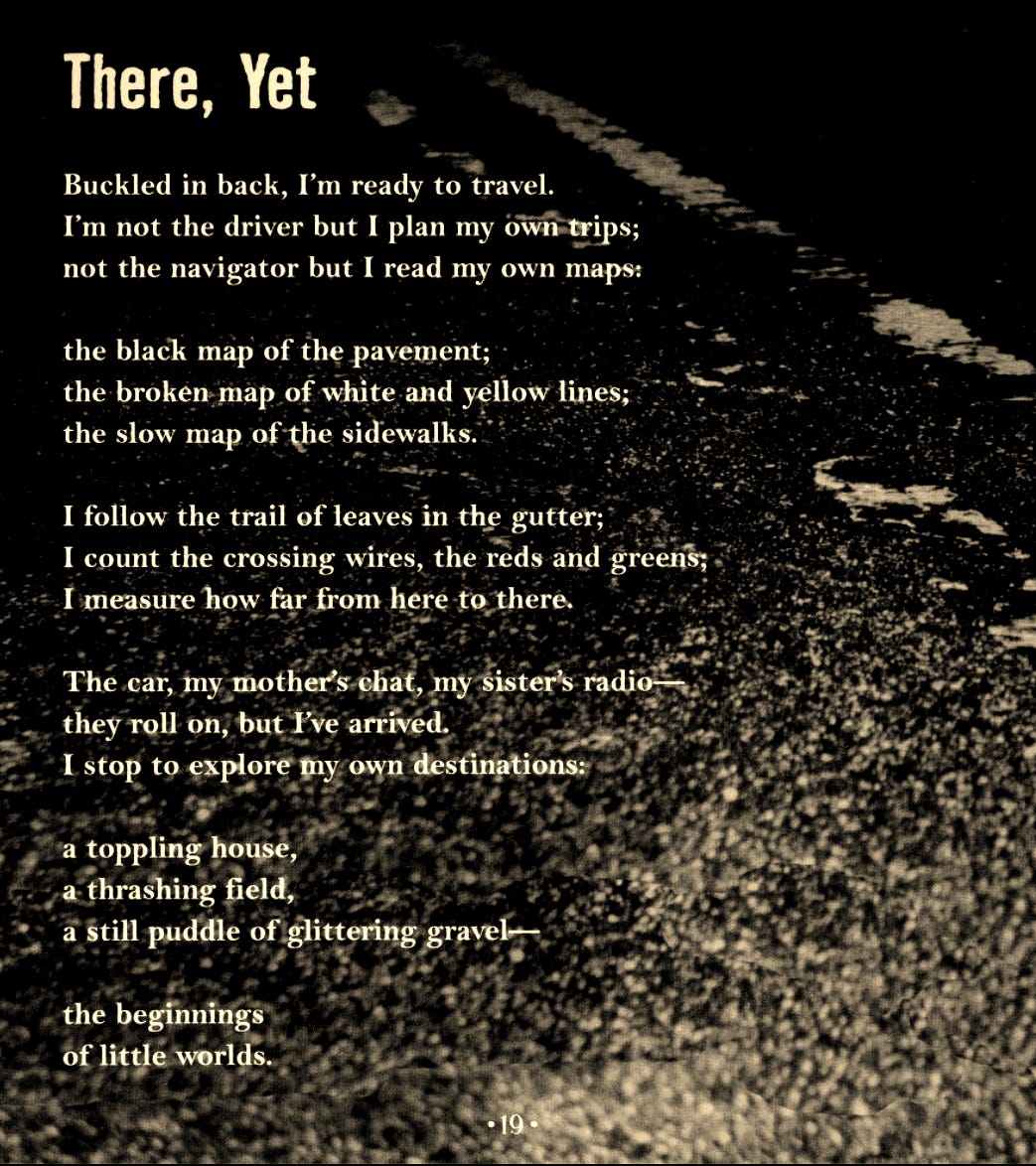
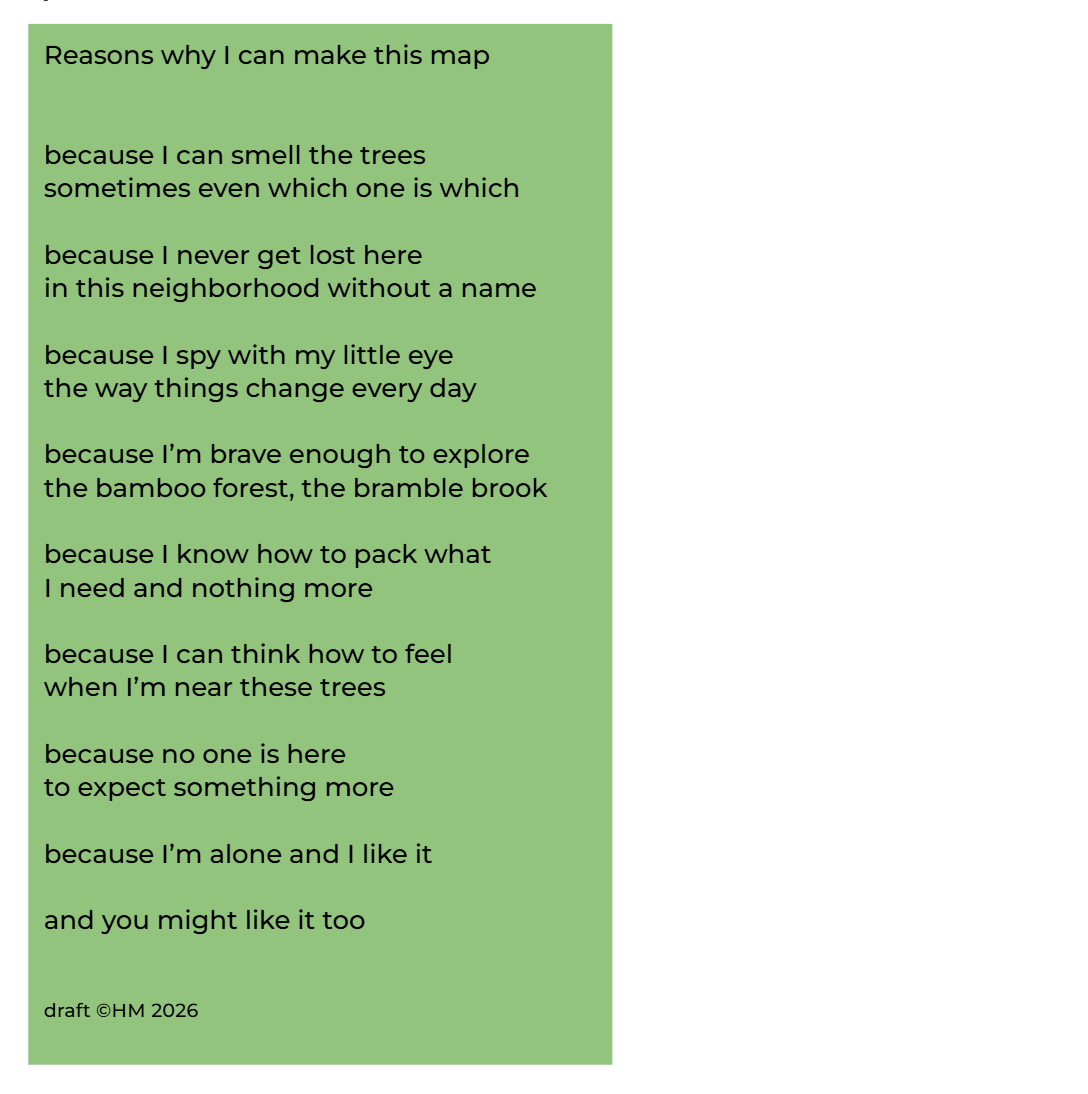
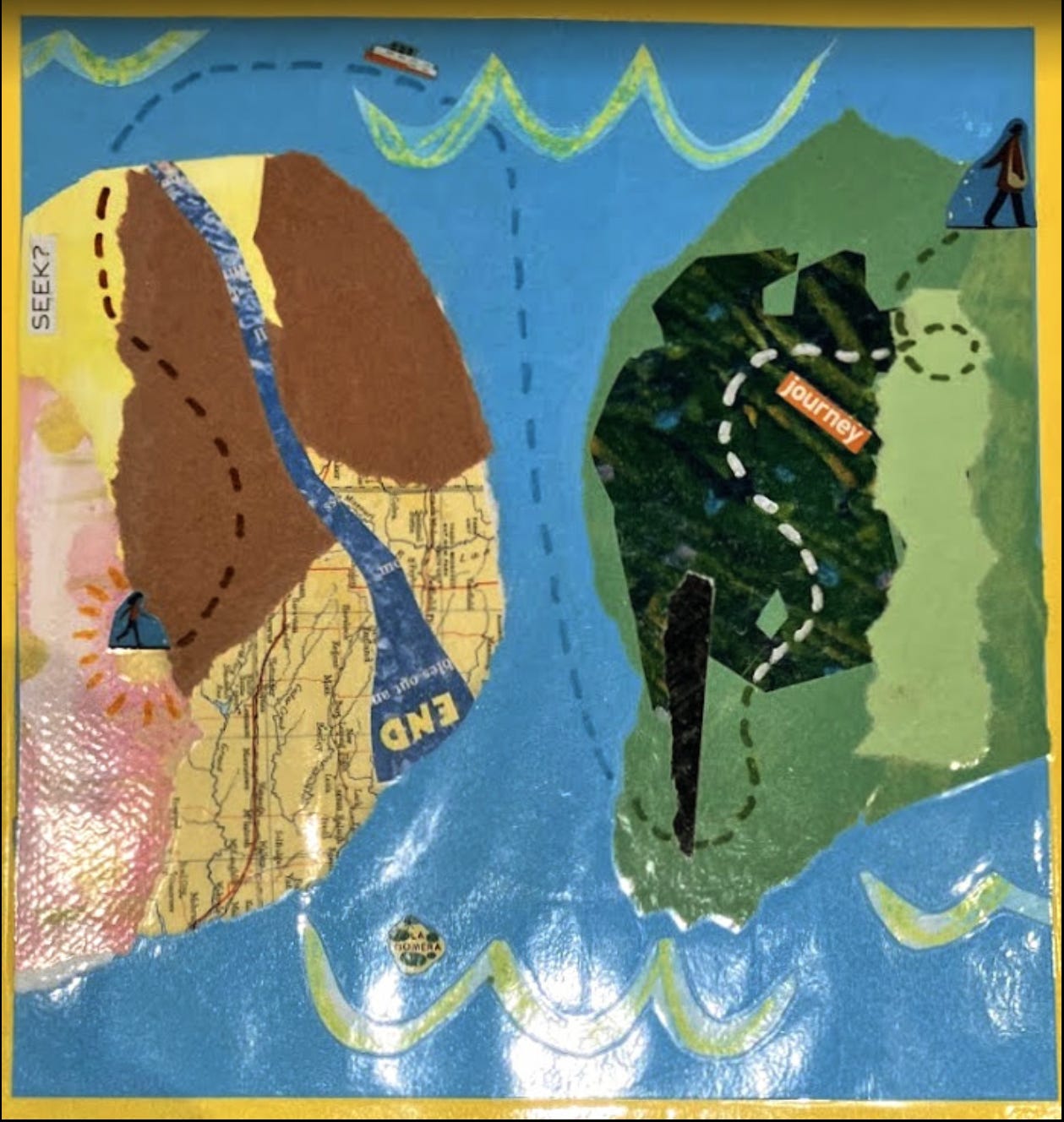
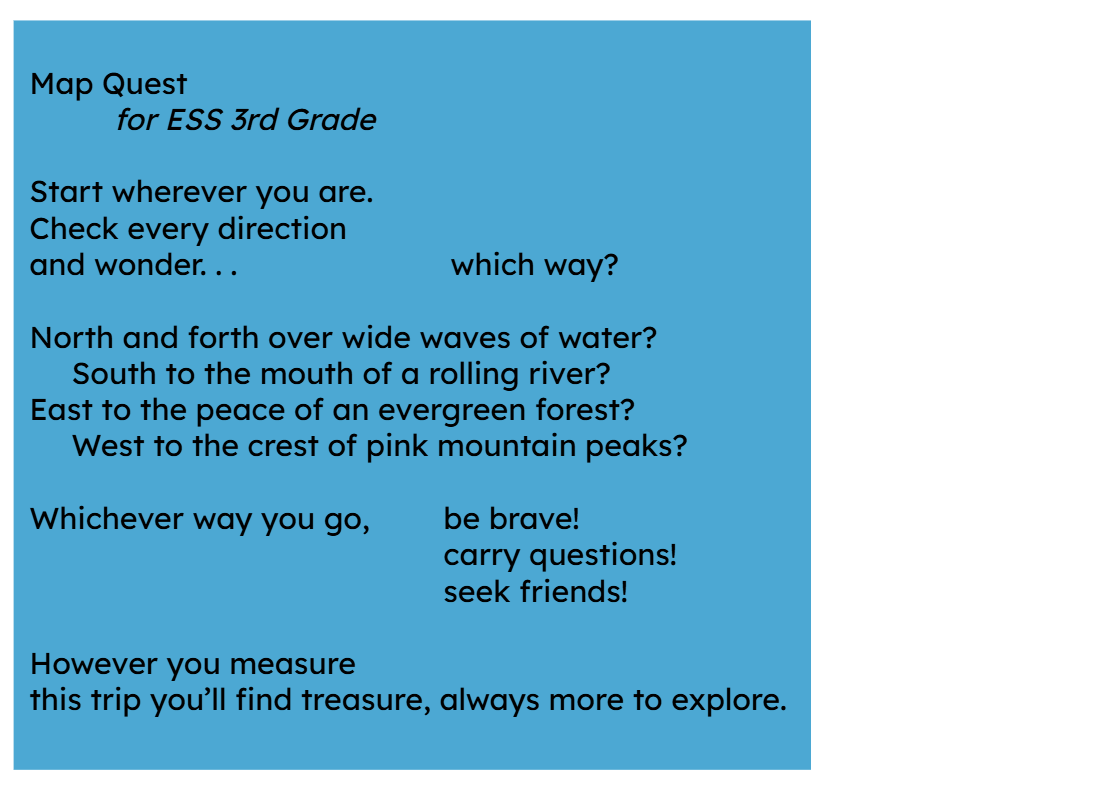
I am all about the big picture, the 30,000 foot view—and that’s what maps provide. The map inside the front cover of the book, the map in the glove box, the map on the board by the trail, the map on your phone…they all lift us up over a place and give us perspective that both increases our power over that place and reminds us how small we are in comparison to it. And of course we carry maps in our minds, where maybe we appear larger than we should—so, gratitude for the external maps that reorient us!Write a poem about maps or travel or journeys, real or imagined. Maybe you want to write about finding your way or marking your path. Maybe you want to consider where your map begins, where it ends, or the liminal boundary spaces. Perhaps you want to take a different perspective— that of the map maker (cartographer if we’re getting fancy :) ) or that of the map itself. Here’s a poem to add to the mix— Elizabeth Bishop’s “The Map”. https://allpoetry.com/The-Map

***However, popular etymology among the later ancients (Servius, Lactantius, Augustine) and the interpretation of many modern writers connects it with religare "to bind fast" (see rely), via the notion of "place an obligation on," or "bond between humans and gods." In that case, the re- would be intensive.
—from https://www.etymonline.com/word/religio-

Greetings, Poetry People, and happy hotter-than-July! I'm grateful to those who have been supporting my efforts over at Substack, intermittent as they have been, and this post is linked there. Comment where you will!
It's the First Friday of the month and the Inklings--6 of us--are responding to yet another of Audrey Gidman's daily prompts from June 5, at Catherine's request:
Read “Digging” by Seamus Heaney. (Really, do!) Think about something that has been handed down to you—from a parent, a grandparent, an elder in your life—that feels alive in you now. Think of how it is the same and think of how it has transformed in you. Notice how, for Heaney, it’s gardening and writing—two kinds of digging, but still the digging continues through the generations. Write a poem that digs into what was handed down to you and examines what you carry now.

Greetings, Poetry People! One of the nice things about being in this community is getting an inside look at our friends' projects. For a long time I've known that Jone Rush MacCulloch was working on something big, but I had no idea how deep and personal was the history of Jone's first novel in verse, TILT. Now, though, I've had a chance to enjoy the full experience of her creative endeavor, and I'm here to tell you it is VERY worth your time!
 |
| Click the cover to go to Amazon |
This beautiful, glowing cover, designed by a parent in Jone's school community, offers the right amount of information. We know that it's a story about a relationship, that the characters are big kids (but not nearly-grown teens); that it's a neighborhood story, not a wilderness one; that trees and birds--are those crows?--will be important; and that all is not sunny in TILTville. Seeing the characters in silhouette, their backs to us, suggests that they are opaque in some way, unavailable in some way. Perhaps it's easy to divine all this in hindsight, but I give kudos to the illustrator and to the clarity of the writing she worked from!
I have to admit that my relationship with verse novels has been strugglesome. My instinct has been to demand that a poem in a story should still be observably, experientially a poem, and for me that requires figurative language. It can't just be musical prose chopped into shorter lines (and it definitely can't be straight-up narrative chopped into shorter lines). On top of the figurative language requirement, I somehow got the idea that each poem in a verse novel should stand on its own, appreciable as a poem even outside of its narrative arc. Happily, I've come to understand that a verse novel is a different beast, and that the metaphorical, figurative ideas can stretch across the arc of the entire work rather than being trapped in single, free-standing poems.
.jpg)
First, there's the pinball image that lends the novel its title, and serves as the anchor for main character Darrah's relationship with her dad, which, like a ball drained by too much shaking, nudging and shoving, has changed forever. Next we have the special oak tree, Garry, who has free-standing poems of his own and is the site of Darrah's important friend relationship with Lily, which also breaks and tilts at the start of the story. The crows come in as a counting rhyme and connect Darrah to her mother, grandmother, and supersitious ideas of fate, which are, just as stereotypes are based on real observations, based on real things that happen to people.
And then there's Jackson, no image, but a living, breathing daredevil mystery-boy who arrives to replace Lily just as 4th grade ends and a long sad summer looms. Jackson is my favorite character, and although Jone establishes by the 25th poem all the necessary bases for everything to come, I finished the novel loving the kid I'd come to know, yet still wondering about who Jackson was, exactly (maybe that's because we didn't get many glimpses of his family, and maybe that was intentional).
This story is full of hurt and fear and stubbornness and misunderstandings of the kind 10-12-year-olds specialize in, along with joy and courage and connection, especially in nature. It's based on events that happened to a real 2nd grader in Jone's school community who died after being mauled by dogs. Jone was wise to move the story up to 5th grade--though of course younger kids also need to read and be comforted and guided by stories in which bad things happen--but to place the story in the voice of Darrah with Jackson and Lily alongside, (after a rocky rapprochement of the two original friends), allows for a convincing and important first-person exploration of personal and community loss. You can tell Jone did a good job with that, because the family of the real Jackson attended her book launch and approved.
Finally, I appreciate the pacing of this novel in verse. It gets going fast, but like the cover, does not reveal too much too soon. It gives a lot of space to the secret Darrah keeps, and although the world is full of pain that comes in various forms and intensities, the adults in the story come through for the kids in the end, and we get to see this happen on a timeline that does not feel tidy and pat, but more like…real life.
And now I’m going to give a very big compliment that I didn’t see coming as I planned this review. Jone’s book, I realize, reminds me broadly of one of my (and possibly your) favorite books of all time: HARRIET THE SPY. Portland 10-year-olds texting on their pink Razr phones seems very far from scribbling in a notebook in 1961 Manhattan, but the complex feelings about relationships and loss are exactly the same 65 years on. I’m comforted to think that we’re not evolving as fast as it sometimes seems.
I'll leave you with one of Garry the Oak's poems:
Trying Out Things
sun
shines
ko-aw--
caa--caa--caa--
fledglings try out wings
someone climbs, hangs from my branches
Jone wrote an amazing post back at the beginning of May when TILT launched. I encourage you to go and read the letter she wrote to her characters. It's so informative about how the book came about, the time and effort that went into making it a creative work of fiction, and how personal our projects are. It's a miracle any of us can make such personal experiences into something others will relate to--or is the miracle that we will, over and over?
Thanks to Buffy Silverman for hosting us today from soggy Michigan!

Greetings, Poetry People! This is my first Blogger post that will also be posted at my fledgling Substack. Find it here!
Bit by bit I hope to shift completely over to Substack for all kinds of functionally modern reasons, with due respect to Blogger for providing *my juicy little universe* with a comfortable home for coming on 18 years. I don't have Substack set up quite as I'd like yet, but I hope you'll recognize me there and subscribe and like and share and all that.
And now, this month's Inkling challenge, simply set by Mary Lee:
Great idea! I often find that I myself am leaving a Poetry Friday blog comment that, inspired by the post itself, becomes rather poetic. In fact I have a running record of such comments of my own that might become something later. But I believe Mary Lee really meant someone else's comment, so I trawled through the Comments page on the back end of Blogger.
I decided, after some internal debate, not to use this one:
🤔
But as I intentionally move into a new commentable space on the Internet, I also have to consider anew what it means to offer my poetic innards up to the public, and this one, from our friend Joyce Ray, caught my eye.

It should have that little extra piece at the bottom with the fault line, "I didn't mean to be Anonymous. It's Joyce Ray," but you see how that's a bit odd in this context. Do you think it's okay to stick with just this?
I didn't mean to be Anonymous.
Thanks to Mona for rounding us up today at her What's New? page. I'm late finishing this post (still have to put it on Substack) but the light of June is now fully illuminating the pretty murky tunnel that was May and I look forward to getting around to everyone's posts!
_____________________________________________________
***FOOTNOTE
"Thou shalt not read the comments section, lest thou covet thy neighbor’s likes. Anyone who uses social media religiously knows that there’s one main rule of the Internet. Well, one main rule besides “CATS, CATS ALWAYS”. It’s to stay outta the comments section; for the love of all that is #holy, stay out of it. Luckily the ever-wise winner of our Internet challenge did the best thing you can do short of hanging a virtual sign on every comments section that says, “HERE BE MONSTERS!”; Rodrigo Leonardo Batista Ferreira (@rodrigobhz) created a design that sums up this number one commandment of the Internet, albeit swapping the stone tablet for a touchscreen one."
---a pretty good explanation of the idea that it's wiser to post without regard to everyone else's responses; take the likes and shares and don't dig too deep, from this post at Threadless where I went to make sure I understood the concept of "Don't read the comments" correctly before I then referred to it in my post title. It's very time-consuming being a person who likes to be as factually accurate as possible all the time. Except in my actual poems, which is why writing poetry is awfully freeing, almost like an anxiety medication.