Friday, June 3, 2011

recomposition

I come to you today from Cabin 21 in Boyds Mills, PA, where I’m attending a Highlights Foundation workshop with David Harrison and enjoying a much-needed creative retreat.

There are times to be grateful for the hovering between asleep and awake that comes during the wee hours. Last week I wrote about visiting my son’s 2nd grade class with a poetry exercise—a new exercise that came to me during one of those thinking-but-not-too-hard moments. No doubt this technique has been obvious to other poetry teachers out there, but I was chuffed when I saw how well it worked to focus children’s attention on the structural aspect of poetry. I asked the children “recompose” one of my poems by cutting the words from an unstructured block and pasting them to create line and stanza breaks.

I picked a short poem from Pumpkin Butterfly, another seasonally appropriate one inspired by my son’s preschool utterances. First I “activated prior knowledge” and checked to see what the kids knew about botany (not much, although they easily identified the sunflower) and the instruments and style of jazz music (quite a bit).

Botanical Jazz

Quiet down, flower—
not so loud!

All this stretching your neck
and spreading your arms
bellowing your brassy yellow sass—

you’re breaking our eyedrums
trumpeting all that color and sun
blowing that blazing yellow jazz. . . .

Belt it out, flower—
we’ll join in!

~Heidi Mordhorst, 2009


I read the poem through twice, very slightly emphasizing the line breaks. (This raises a question that I’d enjoy seeing addressed in the comments: are you a poetry reader of the school that faithfully indicates line breaks in every style of poem, or are you a reader of the school that reads through line breaks in support of the natural phrasing of ideas?) I deliberately didn’t show the page.

Then I handed out a sheet with blank lines—three-quarters the width of the page—at the top and the words of the poem across four fully justified lines on the bottom.

The directions were to think about how to arrange the words to make the poem Sound Good to Your Ears and Feel Good in Your Mouth. Several children were unsure at first whether they had to use all the words—they thought I was asking them to reWRITE the poem—so guidance was needed : “Keep all the words of my poem in the same order, but you decide how many words to put on a line; you decide how many stanzas to make.” I made a big deal of it when I noticed Alexandra quietly reading her arrangement out loud to test the sound of it—“that’s exactly what poets do!”

Here are just three of the varying arrangements that the kids came up with.

Quiet down, flower—
not so loud!
All this stretching your neck
and spreading your arms bellowing your brassy yellow sass—
you’re breaking our eyedrums
trumpeting all that color and sun
blowing that blazing yellow jazz. . . .
Belt it out, flower—
we’ll join in!

H.T.


There were several kids who strung the gerund phrases into long lines like this. This one was very deliberately centered and shaped, which I can't easily reproduce here.


Quiet down, flower—not so loud!

All this stretching your neck and spreading
your arms bellowing your brassy yellow sass—

you’re breaking our eyedrums trumpeting
all that color and sun

blowing that blazing yellow jazz

...Belt it out, flower—we’ll join in!

C.I-C.

That's one of a few where stanza breaks were employed, and the new enjambments are quite effective…

Quiet down, flower—
not so loud! All this stretching
your neck and spreading your arms bellowing
your brassy yellow
sass—you’re breaking our eyedrums
trumpeting all that color and sun blowing
that blazing yellow
jazz…Belt
it out,
flower—we’ll
join in!

J.S.

And that's one where, without realizing she was doing it, the student’s arrangement resembled the head of the sunflower on a five-line stem!

These new imaginings absolutely have me questioning whether the published arrangement of “Botanical Jazz” is the ideal one…

But the very best surprise came from Jack O., who was concentrating so hard on his cut-and-paste task that he was halfway through rewriting a new poem before I caught up with him. It was too late to go back, so I encouraged him to finish, and boy, did he make this set of words his own! He even cut out individual letters to spell new words he needed. How confident! How clever! (Please note that Jack has experience of tae kwon do—we used to see him there every Thursday. Did this influence his recomposition?)


Jack’s Botanical Jazz

Quiet down, flower—your so loud!

you’re breaking our neck your

yellow jazz and yellow color e d

Belt i s blowing u s a w a y


Wow, right?


Today’s Poetry Friday Roundup is hosted by Toby the Terrific at The Writer's Armchair. See you there!

Friday, May 27, 2011

in print for the first time!


Welcome all visitors, new and seasoned! I'm looking forward to rounding up your poetry posts throughout the day, and I'm delighted also to share poems by 2nd graders from Mr. Gamard's class at Wyngate Elementary School here in Bethesda. Before I arrived, Mr. Gamard had laid the foundations for some very productive poetry work.

On Wednesday I spent 75 minutes sharing
"Honeysuckle Hunting" and talking about how poetry tools like alliteration, personification and onomatopoeia are powerful--but how they work best in a poem about something that really matters to the poet. The children then drafted new poems. There was "Can I?" and "How should I?" and "Are we supposed to?" -- to which I always answer, "You are the boss of your poem."

On Thursday my aim was to highlight the freedom poets can exercise in arranging their poems on the page to help readers read it "right." I brought in
"Botanical Jazz" printed across four left-justified lines (contrary to its appearance in the book), and after reading it aloud twice without showing it, I asked the children to cut and paste the words of the poem on lines, creating line breaks and stanzas. This turned out to be both challenging and instructive, and the kids enjoyed trying out the different readings commanded by their varying versions while comparing their own arrangements with each others' and with mine. More on this exercise next week....

Then they went back to work with their drafts, to reconsider arrangements on the page, word choice and pacing--or just to elaborate their illustrations. They were rather excited to think of their work being published on the World-Wide Web, and so without further ado (Okay, a little further ado: as always, I'm not able to preserve all the indents, so apologies to young writers who intended a little more variety in the shape of their poems)....THE POEMS!


Mouse
by Peter D.

Creeping crawling sneaking. Stealing
cheese.

Living in dark holes.

Always staying out of sight.
Always sneaking food at night.
Jumping out of sight when the
cat comes.

Brown, black, gray, white mice!


What am I eating?
by Danielle P.

The reds are
like SHINY red apples.

The oranges are
like JUICY tangerines.

The yellows are
like SOUR lemons.

The greens are
like
SWEET
lime.

The
purples
are
like BITTER grapes.

now I’m
eating SKITTLES!!!!!!


Drawing
by Cooper M.

Action!
I take my pencil and draw a circle.
Then a straight line down the bottom of the
circle. Then one line going to the right.
Then I draw one line
going diagonal and…
wow! You’ve got a troop. But make more!


The Night Is Like A Cat
by Kit F.


The night is like a big black cat

the moon is like his eye

with a gleaming glow of mischief sailing

across the sky.

The night is like a prowling cat

watching all the stars

which are like the mice

that make their home in ours.

Now you know that

the night is like a cat.


football
by Ryan G.

Hike
whoosh
the football flies through the air
click clank
the players crash together
he catches the ball
TOUCH DOWN!!!
BOOM!
he kicked the field goal everyone is out of
their seats
It’s good!
the Redskins win!


Monkey
Jeanne F.

I saw a monkey,
I saw a monkey! It
climbed on a tree. It climbed
a branch so high so far.

It pretended it was
on monkey bars! Now look
what I found I saw
it’s eating a banana.

It is so high it might
soon touch the sky.
Now please come and look
Please, Please, Please
I said please too many times
can you please come?

Please?


the Forest
by Jack M.

Deep in the forest where the deer
dance,

deep in the forest where the chipmunks
chirp “chirp, chirp,”

deep in the forest by the pond if
you listen you can hear “deep deep”
“deep deep,”

then, boom!
The hunters are coming!
quick, time to go home!


The Night Poem
by Hannah T.

A creepy sound in my bed that
goes “squeak, squeak” and a scary noise
in the moon like an owl going “who, who.”

The moon sets up when the sun
goes down and the same thing
happens around and around.

The night is like a big black
cat.

The noises in the night may
give you a slight fright.

Anything can happen in the
night, anything can happen here,
anything can happen there.

Right and left, here and
there night can freak you anywhere.

Peaceful dream relaxes your thoughts.

Within the night the stars
will shine and let it be good night
for bed time.


Skittles
by Elana R.

They taste so
GOOD.
Extremely good.
Skittles taste like
fruit
Ripe fruit
Perfectly ripe fruit.
Suck, suck till the flavor comes out.
Very
Chewy
Never swallow
them whole

Skittles, Skittles,
such powerful taste

Suck and suck
and before you know it they’ll be gone for today.


Halloween
by Jack O.

There’s lots of knights
fights for lots of gold
look over there!...
at the monsters with lots of gold
you just have to touch the monsters’
hair and you get the gold
but some have a rule 3 pieces each
then you get the glimmering gold
now to the next monster


ice cream
by David G.

Slurp! Slurp! Slurp!
Licking ice cream.

Drip! Drip! Drip!
Aaaaa! Ice cream melting.

Crunch! Crunch! Crunch!
Eating the cone.

Delicious.

Dodgeball
by Collin K.

Throwing balls 50 miles per hour
hitting people in the feet
ducking at fastballs
diving for catches
slides, monkey bars, swings
all around you
bright sun, light blue skies, white clouds
what a great day for dodgeball
we finally got him out
we win
YEAH! YEAH!


Look for Honeysuckles
by Olivia B.

Sniff smell the
honeysuckles. There on the
sweet honeysuckle tree.
I love it I see it.
They’re sweet they’re tasty
they’re amazing. They taste like
sweet juicy honey. Honey, honey,
the sweet of a honeysuckle
Hmmm when I taste it
first it looks gross.
When I taste again
I love it. Wait Stop!
We should save more for
later.


Dreaming Dogs
by Jordan F.

Dogs dogs, Dreaming day and night.
Dogs dogs, They never have a
fright.

Dogs dogs, Their minds are so
insane.
Dogs dogs, They always play all
day with owners.

Dreaming about having a dog
is the best dream.


Cats
by Conor C-I.

Furry balls of fluff and happiness.

Meow! The call for friends, family.

Cats are like balls of fluff scurrying about.

Purrrr! A happy cat's call, a calm cat's call
.


Dragon Hunting
by Luke D.

We search all day but we may not find
it, the great chinese dragon we search day and
night.

I hear it swooshing through the grass
I see two glowing eyes I must say, there we finally
found it

David sneaks behind it and catches him
in a net

thanks to us americans have finally
found the first dragon


And now for contributions from the KidLitosphere:

*April Halprin Wayland was in early with notes on teaching revision at
Teaching Authors.

*Charles Ghigna has an artist poetraits (poem portraits) over at
The Bald Ego. This week's artist is Mary Cassatt.

*Tabatha has genetic poetry at
The Opposite of Indifference.

*Sally weighs in from Japan on friendship at
Paper Tigers.

*Mary Lee is winding down her school year with Annie Dillard at
A Year of Reading.

*Carol is doing the same with last-day-of-school poems at
Carol's Corner.

*Julie has a little rittle (or a liddle riddle) at the excitingly redesigned
Drift Record.

*Toby shares one of her Wind Voices at
The Writer's Armchair.

*Jama serves up a helping of bilingual rice pudding at
Alphabet Soup.

*Ruth connects with Shakespeare across the centuries at
There Is No Such Thing As a Godforsaken Town.

*Diane comes to us threefold as usual: with X J Kennedy at
Random Noodling, with fireflies at Kurious Kitty, and a word from John Fowles at Kurious K's Kwotes.

*David does the henhouse hop at
Fomagrams.

Your host will return around 2:00 to continue the round-up, ....and here I am.

*Dori has yet another end-of-school poem at Do
ri Reads--why does my last day still feel rather far away?

*Robyn has a birthday post for Bob Dylan at her
homebase.

*Elaine shares a fax from the Seven Dwarves to Snow White at
Wild Rose Reader! And another fairy tale poem at Blue Rose Girls.

*Steven has a beachcomber poem inspired by his daughter at
Crackles of Speech.

*Laura has student poems about food--always a fine inspiration--at
Author Amok.

*Blythe continues to explore allusion with her own
Lost World poem.

*Sheri has a
forest walk poem from Kristine O'Connell George at her blog today.

*Barbara marks Memorial Day with a William Stafford poem at
The Write Sisters.

*Carol offers a snippet of Sondheim at
Rasco from RIF.

*Shelley has another installation of
Dust Bowl Poems to share.

*Janet Squires reviews A Child's Introduction to Poetry at
All About the Books.

*Ms. Mac has first graders' animal poems at
Check It Out.

*Lastly, I'm terribly sorry but I accidentally deleted one of the later comments without even registering its provenance--if you're missing, do please let me know!

Happy holiday weekend, everyone! And many thanks to the poets and parents of Mr. Gamard's class....


Thursday, May 26, 2011

Belt it out, flower--we'll join in!*

Poetry Friday here tomorrow and feeling summery at 90 degrees...


Many delights await, since I had an opportunity to do some poetry work with my son's second grade class this week; virtual permission slips are rolling in, which will allow me to share some of their really individual, skilled and charming work.


I'll collect the breakfast links around 8 am (or, if I can persuade Mister Linky, he'll do it), be back for a late lunch around 2 pm, pop off for a job interview and come back for nightcaps after 9. See you tomorrow!

*from "Botanical Jazz," Pumpkin Butterfly, 2009


Friday, May 20, 2011

annual honeysuckle poem, ahead of schedule


you! I wrote your poem already
last year and the year before that...
but this afternoon
blue blasts through the cloud cover;
I round the corner, bent on an ordinary errand,
shoot through a fleet scent
like a warm spot in the sea
and stop, stock-still:
what was that streak of happy?

stepping back the smell swells;
goodmorninghellohappynewyear it's you!

slipping the stamens (forgiving the
gajillion green raindrops of the week)
lights fireworks inside my face
and each white or yellow trumpet blossom
gets under my tongue and under my feet
giving me nectar-fueled jetboots
that blast me above cloud cover,
let me hover over May, over today,
and sight the fence of a far-off June
where I learned to suck honeysuckle


Is it crazy to be walloped so soundly every year by the same short-lived miracle? I stood yesterday enjoying my son's enjoyment, remembering my daughter's (see previously published ode below), but selfishly relishing my own surrender to The Sensory Power of the Honeysuckle Experience. (Ooh, and when I play in a band, after we finally negotiate an 8th day of the week, it will be called The Honeysuckle Experience.)


Honeysuckle Hunting

It could be anywhere.
We stand stock still and sniff
the green breathing of daisy, vine and leaf.

Ears pricked and noses high,
we listen for the drowsy hum
of yellow golden honey.

There, on the fence!
We'll steal it from the bees,
pluck a tiny trumpet blossom,

pinch the end with finger and thumb,
like biting the vanilla-dripping tip
of an ice cream cone.

Slowly, slowly, draw it out--
pull the stamen through, tongue poised
to catch one crystal drop of sweetness.

~Heidi Mordhorst
from Squeeze: Poems from a Juicy Universe, 2005

Join Julie at The Drift Record for this week's Poetry Friday roundup!

Friday, May 13, 2011

trying hard

As regular readers know, I’m in the throes of a hot little love affair with Alice Oswald. (Her poetry, I mean.) It’s inspiring me to push out in a new direction in my own writing, and the poems coming along are not for children, necessarily. In fact they may not be for adults--yet.

I took a couple to my long-standing critique group this week, and although there were things to like in my new-style work, for the first time in a while my two friends expressed concerns about being able to “get” the poems. We had an interesting discussion, which I’ve been continuing with myself, about the long-standing question of how our readers “hear” our work when we’re not there to guide them. When I write a poem, I mean something definite if in motion; I’m working to convey an idea and, always, what you might call an opinion about that idea, a feeling that accompanies the small knot of thought that the words of the poem are trying to untie.

But I know, and have come to accept, that when others read my poem they will likely perceive something quite other than what I have worked to convey. I don’t begrudge them their interpretation one bit, and yet it’s an odd feeling to have people who know and love you (including your own father) saying, “I don’t get this.”

And yet, I don’t “get” quite a lot of Alice Oswald—her writing is not clear and concrete despite its clarity and the richness of its concrete details. As in the poem I posted last week, we ride straightforwardly along a Roman road but the “rococo curves” of experience draw us into the neck-high bracken, powerfully. Alice’s work is often described as visionary, and to me it does feel “out there.” I’m attracted to the stuff that’s out there, that’s quite beyond how I would talk to myself about the subject of a poem. I like daring and surprise, which is why I am also a fan of e.e. cummings and Gerard Manley Hopkins. After all these years there is mystery for me in many of their poems; their work remains visionary and I have to try to access that vision and still I don’t know that I get it all. (And one of my goals as a teacher is to let children know that comprehending poetry doesn’t necessarily mean “getting it.”)

My aforementioned father, recently become a student of poetry, sent me a fascinating interview with Christian Wiman, editor of Poetry Magazine, that was published in the Christian Century. Here’s one piece of it:

Amy Frykholm:
One sometimes hears arguments about the role of difficulty in
contemporary poetry—whether difficulty can play an essential
role or is simply an obstacle. What do you think? Or is the issue
not important?

Christian Wiman:
I think the argument is largely a canard. Here's a line from that Susan Howe book (That This) I'm reading: "You steal on me you step in close to ease with soft promise your limit and absolute absence." Is this "difficult"? When I first read it, I admit to having been slightly annoyed at its syntactical confusion, its absence of clarifying punctuation.

But something made me keep reading the sentence over and over—all those soft subsiding vowel sounds mixed with the monosyllabic urgency, the mysterious nature of the encounter being described, the way the line makes you feel something of that encounter and even participate in it. It could be describing our relationship to God.

As it happens, Howe is talking primarily about her dead husband, but the point is: there's no other way of saying what she's saying here. The language is action. Great poetry is usually difficult in some way, and then clear in ways we would never expect. Its difficulty, you might say, makes new clarities possible in and for us. "I wanted to write a poem / that you would understand," wrote William Carlos Williams. "For what good is it to me / if you can't understand it? / But you got to try hard."


Coming back around to the question of whether it’s the poet’s responsibility to make her poem “gettable” to readers, I found this bracing reminder in a Thomas Lux collection I picked up, looking for bedtime reading with my 12-year-old. It insists that we write for ourselves, mainly, just as we read for ourselves, and it all works best when we try hard.

THE VOICE YOU HEAR WHEN YOU READ SILENTLY

is not silent, it is a speaking-
out-loud voice in your head: is it spoken,
a voice is saying it
as you read. It's the writer's words,
of course, in a literary sense
his or her voice, but the sound
of that voice is the sound of your voice.
Not the sound your friends know
or the sound of a tape played back
but your voice
caught in the dark cathedral
of your skull, your voice heard
by an internal ear informed by internal abstracts
and what you know by feeling,
having felt. It is your voice
saying, for example, the word barn
that the writer wrote
but the barn you say
is a barn you know or knew. The voice
in your head, speaking as you read,
never says anything neutrally — some people
hated the barn they knew,
some people love the barn they know
so you hear the word loaded
and a sensory constellation
is lit: horse-gnawed stalls,
hayloft, black heat tape wrapping
a water pipe, a slippery
spilled chirr of oats from a split sack,
the bony, filthy haunches of cows. . . .
And barn is only a noun — no verb
or subject has entered into the sentence yet!
The voice you hear when you read to yourself
is the clearest voice: you speak it
speaking to you.

~ Thomas Lux

The Poetry Friday Roundup is deliciously, sassily hosted today by Jama at Alphabet Soup. Step on over for a taste of the hot stuff!


Friday, May 6, 2011

alice springs

In the mail from Altrincham, England came an unassuming little volume, The Thing in the Gap-Stone Stile. It's Alice Oswald's first book, published in 1996 and now in reprint from Faber and Faber. I take the liberty of posting a complete poem here as a way of making sure as many of us Americans get to know this work as possible.

Really there are half a dozen I'd like to post. She's changing my poetry brain, but I need more time to understand why and how.


Bike Ride on a Roman Road


This Roman road — eye’s axis
over the earth’s rococo curve —
is a road’s road to ride in a dream.

I am bound to a star,
my own feet shoving me swiftly.

Everything turns but the North is the same.

Foot Foot, under the neck-high bracken
a little random man, with his head in a bad
controversy of midges,
flickers away singing Damn Damn

and the line he runs is serpentine,
everything happens at sixes and sevens,
the jump and the ditch and the crooked stile . . .

and my two eyes are floating in the fields,
my mouth is on a branch, my hair
is miles behind me making tributaries
and I have had my heart distracted out of me,
my skin is blowing slowly about without me

and now I have no hands and now I have no feet.

This is the road itself
riding a bone bicycle through my head.

~ Alice Oswald
The Thing in the Gap-Stone Stile, 1996

Poetry Friday is at The Family Bookshelf today (I can't link to it because the site keeps shutting my browser down--anyone else?). Happy Mother's Day to all, especially to my own mother, and to my English mother-in-love (no laws pertain to mothers except those of the heart, who celebrates on a whole different day and who sent me this book.

Friday, April 29, 2011

a way


a way

I am not
coming
for now; the five thousand
steps are
too far
and your stones
are pushed down,
buried by sifting, thickened
drifts beyond
my bare foot's reach


another year maybe
clouds
will thin, expand
cast a light
rain along your bounds
so that even this blind
I might find
a way across
again, arrive
alone, alive


~ Heidi Mordhorst 2011
all rights reserved

Friday, April 22, 2011

mission accomplished


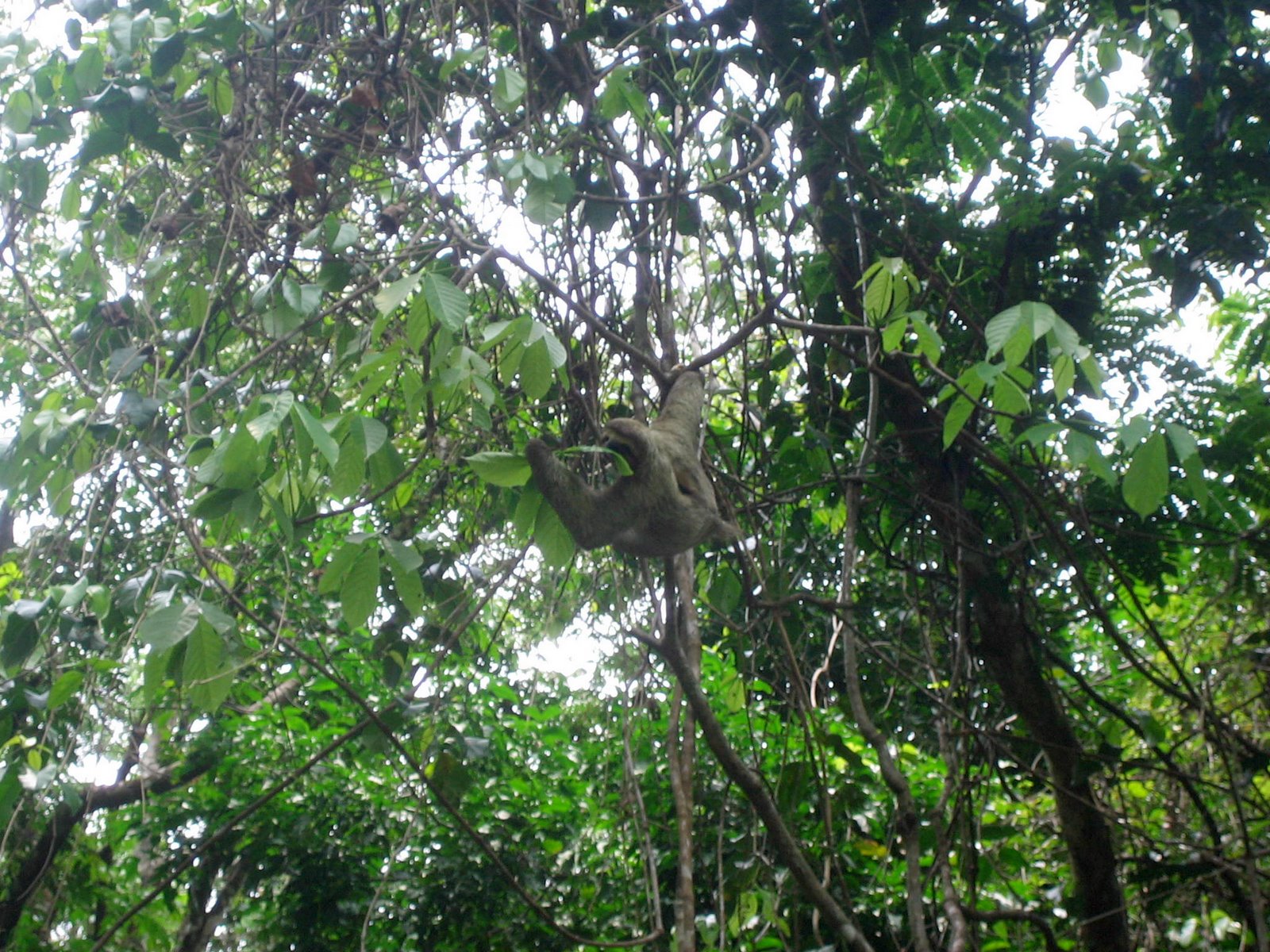
Yesterday: sloth in Manuel Antonio National Park. Today: sloth by the pool. Pura vida!
Posted by Picasa

Friday, April 15, 2011

the middle is the end and the beginning

In our school district, teachers have been teaching (and testing) for 9 weeks straight without a day off, and if you count all the way back to January, for 15 weeks with only a couple of 3-day weekends to catch a breath. This middle day of April is the end of one butt-kicking passage of time, and the beginning of the most exciting, most needed Spring Break I've had in...in...in EVER. We're going to Costa Rica!


I'm thankful that I'll still be a presence during NaPoMo, thanks to TOMORROW's post by Gregory K featuring "The Playroom Floor Writes a Novel" at 30 Poets/30 Days, and thanks to Laura Shovan at Author Amok, who is including a new poem of mine in her NaPoMo project featuring Maryland poets TODAY!

For now, in honor of both the wildlife I hope to encounter in Costa Rica and the lifestyle I hope to enjoy there, a classic by Theodore Roethke:

The Sloth


In moving slow he has no Peer.


You ask him something in his Ear,

He thinks about it for a Year;


And, then, before he says a Word

There, upside down (unlike a Bird),

He will assume that you have Heard--


A most Ex-as-per-at-ing Lug.

But should you call his manner Smug,

He’ll sigh and hive his Branch a Hug;


Then off again to Sleep he goes,

Still swaying gently by his Toes,

And you just know he knows he knows.


~ Theodore Roethke


Today's roundup will find us all wrapped up in noodles by Diane Mayr at Random Noodling.

Thursday, April 7, 2011

alice oswald

When I taught in England in the 90's, I was truly surprised to find how few of the books I grew up on--picture books and classic middle-grade novels both--were known at all in the UK, and how many British classics were, in turn, unknown to me. I guess it was surprising because of the place of authors like A.A. Milne and Beatrix Potter in the American canon, which could lead a reader to believe that their lesser-known British compatriots were better represented on the library shelves. I just assumed that similarly, Arnold Lobel and Beverly Cleary and their compatriots would be represented in English libraries, but no one there had ever heard of The Mixed-Up Files of Mrs. Basil E. Frankweiler!

Although the Atlantic is perhaps not so deep a divide these days, when it comes to poetry the crossover may still be difficult. I think so because of a beautiful book, not published here, given to me by my English mother-in-law. It's Weeds and Wild Flowers by Alice Oswald. Her name was new to me, but for the past 15 years or so (her first book came out the year I left London) she has been rising to the top of the milk can of British poetry.

This collection, for adults but accessible to the YA audience, is striking in its conception, mood and presentation. Each poem is titled with the uncommon name--in most cases unfamiliar to me--of a common plant; Oswald then develops each into a character described in a voice which is so spare and so intimate that when I went to find out more about Alice, I was a little shocked to realize that she actually has an "ordinary" human family. Her deep knowledge of each of these plant-people had me believing that these were her relatives.

Here's a poem for April, not my favorite in the book, but which well represents the prickly surface of her carefully structured pieces.

Primrose
First of April – new born gentle.
Fleeting wakeful on a Greenleaf cradle.
Second of April – eyes half open,
Faint light moving under lids. Face hidden.
Third of April – bonny and blossoming
In a yellow dress that needs no fastening.
Fourth fifth sixth – she somehow stands
clutching for balance with both hands.

Seventh of April and tiredness shows.
No rest for three days in unwashed clothes.
Asks (eighth of April) for a little water.
Asks asks until the lips dry out. No answer.
Ninth of April. Head flopped over.
Contorted with headache. Seated figure.
Twelfth of April – eyes half closed.
No light moving under lids. Tense pose.

April the thirteenth. Almost dead.
Face like wet paper. Hanging yellow head.
Still there. Still dying. Fourteenth of April.
Face fading out. Expression dreadful.
Fifteenth sixteenth. So on so on.
Soul being siphoned off. Colour gone.
April the seventeenth. Dead. Probably.
Skull in the grass. Very light and crumbly.

~ Alice Oswald from Weeds and Wildflowers, 2009

The monotone etchings by Jessica Greenman intensify the experience of reading this book--simple yet deeply detailed, restrained yet wild the way we are inside our seed-bearing heads.

The schedule says we're all converging at Madigan Reads this week for Poetry Friday.

Tuesday, April 5, 2011

I get around

April is fun, fun, fun! We all know that poetry is for all times of year, but what poet isn't revved up by the knowledge that this month a nationwide poetry party is going on all night, all day, all ways? I've had some lovely invitations this time around. Look for my work and what wisdom I have to share at these sites. I'll add specific dates when I know them.

ReaderKidz featured essay, "Making a Meal of Poetry" , up now!


Jama Rattigan's Poetry Potluck:"Lasagna Factory," later this week


Gregory K's 30 Poets/30 Days at gottabook later this month:

"The Playroom Floor Writes a Novel"


And in the March issue of the ALA's Book Links magazine, "April Gale" from Pumpkin Butterfly starts off a game of Poetry Tag in Sylvia Vardell's poetry column and features another of my poems offline.

Enjoy!

Friday, April 1, 2011

the fuellest month

My universe turned very juicy indeed on April 1, 1999: on this day was brought forth the fresh, hardy, thrive-anywhere perennial who is my daughter Daisy. Nowadays, what with her ever-changingness, the launch of National Poetry Month, all this spring ("as it comes bursts up in bonfires green,/Wild puffing of emerald trees, and flame-filled bushes"), the first day of April seems to fill up my tank and fuel fresh starts and forward thrust. Heaven knows I need that! (I also need packages that arrive unexpectedly filled with crazy faith and chocolate-peanut clusters, but that's a whole 'nother heart-tickling story...)

I had a few poems in mind for today's post but now I have a better idea, if you'll join me in some April Fuellishness: a poetry game. I'll start, and as your comment you'll add a line to the poem. It's MiniPoetryTag!

It might work best if you cut and paste previous lines into the comment box before adding your line. My job will be to come back this afternoon and wrap the whole thing up, wherever it may have taken us. Ready? (And don't forget to visit Amy at the Poem Farm for all the rest of Poetry Friday.) Here goes....

*******************

Fresh starts, forward thrust--

[to you!]